For decades, the story of Stanley Meyer has fascinated millions around the world. To some, he was a visionary inventor who discovered a revolutionary way to power vehicles using water. To others, he was a controversial figure whose claims never stood up to scientific scrutiny. Yet nearly three decades after his death, his name continues to fuel debate, speculation, and conspiracy theories.
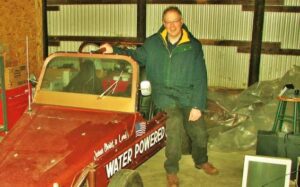

Born in Ohio, USA, in 1940, Stanley Meyer became widely known in the 1980s and 1990s after claiming he had invented a “water fuel cell” capable of powering a vehicle using ordinary water. According to Meyer, his technology could split water into hydrogen and oxygen using far less energy than conventional methods, allowing a car to run almost entirely on water. He even showcased a dune buggy that he claimed could travel long distances using only water as fuel.
The invention attracted enormous attention. At a time when the world was heavily dependent on fossil fuels, the prospect of a vehicle powered by one of Earth’s most abundant resources seemed revolutionary. Investors, journalists, and curious onlookers flocked to learn more about the technology. Meyer filed several patents and promoted his invention as a solution to global energy challenges.
However, not everyone was convinced.
Scientists and engineers questioned Meyer’s claims, arguing that they violated fundamental laws of physics. Experts noted that extracting hydrogen from water requires energy and that the process could not produce more energy than it consumed. In 1996, two investors sued Meyer, accusing him of fraud. After examining the technology, an Ohio court ruled that the invention was not the breakthrough Meyer claimed it to be and ordered him to repay the investors.
Then came the event that transformed Meyer from a controversial inventor into the center of one of the world’s most enduring conspiracy theories.
On March 20, 1998, Meyer was attending a meeting with potential investors at a restaurant when he suddenly became ill. According to accounts from his brother, Meyer ran outside, collapsed, and reportedly exclaimed, “They poisoned me” before losing consciousness. He later died. The dramatic circumstances surrounding his death immediately sparked rumors that powerful interests had silenced him to prevent his technology from reaching the public.
Supporters of the conspiracy theory argue that a successful water-powered vehicle would have threatened powerful oil and automotive industries. As a result, they believe Meyer was assassinated to protect existing economic interests. The story spread rapidly through documentaries, websites, and social media, turning Meyer into a legendary figure among alternative energy enthusiasts.
However, official investigations reached a different conclusion. Authorities and the Franklin County coroner determined that Meyer died from a cerebral aneurysm, a medical condition involving the rupture of a blood vessel in the brain. Toxicology findings and the official investigation found no evidence that he had been poisoned. Despite this, speculation surrounding his death has never completely disappeared.
Today, Stanley Meyer remains one of the most debated inventors in modern history. Whether viewed as an innovative dreamer, a misunderstood entrepreneur, or the subject of an enduring conspiracy theory, his story continues to captivate people around the world. What is certain is that no commercially viable vehicle capable of running solely on water has ever been proven to work, and Meyer’s claims remain unverified by mainstream science. :::