When most people think of Kenya, images of the world-famous Maasai Mara, majestic wildlife, and the proud Maasai and Samburu communities often come to mind. Yet far from the country’s celebrated safari destinations, on the remote shores of Lake Turkana near the Kenya-Ethiopia border, lives a little-known community fighting a silent battle against extinction—the El Molo.
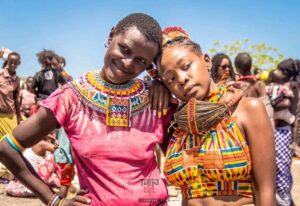

Known as Kenya’s smallest and most endangered indigenous community, the El Molo number fewer than 1,000 people. They inhabit small villages such as Komote and Layeni in Marsabit County, near Loiyangalani, along the southeastern shores of the vast Lake Turkana. For generations, they have lived a unique way of life centered around the lake, setting them apart from the pastoralist communities that dominate northern Kenya.
Unlike their neighbours who depend on livestock, the El Molo are traditional fisherfolk. Their survival has long depended on the waters of Lake Turkana. Armed with handmade harpoons crafted from acacia roots and fishing nets woven from doum palm fibre, they venture into the lake on rafts constructed from doum palm logs. Their skills on the water have been passed down through generations, forming the backbone of their cultural identity.
The El Molo’s homes reflect their close relationship with nature. Their rounded huts, built along the lakeshore, are made from doum palm fronds and supported by sturdy acacia wood. Like the Samburu, they adorn themselves with colourful beadwork, necklaces, and bracelets. Traditionally, they wore garments fashioned from goat and fish skins, often decorated with fish bones and teeth. While elders continue to embrace these customs, younger generations are increasingly adopting Western-style clothing, raising concerns about the gradual erosion of traditional practices.
Life in the harsh Turkana environment has never been easy. The community has historically faced significant health challenges, poor access to medical care, and a limited diet heavily dependent on fish. As a result, life expectancy has often been lower than the national average, while maternal and child mortality rates remain a concern.
Adding to their struggle is the gradual loss of their language and cultural identity. Years of intermarriage with neighbouring communities have accelerated assimilation, threatening traditions that have survived for centuries. Community elders fear that the unique El Molo language may soon disappear completely.
One of the most revered achievements among the El Molo is the hunting of a hippopotamus. Within the community, this act is regarded with the same honour that the Maasai traditionally accorded to lion hunting. A successful hunter is celebrated as a hero, decorated with ornaments made from hippo teeth, and honoured with a communal feast. Such ceremonies serve as a reminder of the tribe’s deep connection to Lake Turkana and its wildlife.
Despite their peaceful lifestyle and lack of livestock—which largely shields them from the cattle raids common in northern Kenya—the El Molo have not escaped conflict. In 2007, tensions with neighbouring communities sparked fears that the already fragile group could be wiped out. Many reportedly fled by swimming to nearby islands to escape the violence.
Perhaps the greatest threat facing the El Molo today is not conflict or poverty, but cultural extinction. Elders say that fluent speakers of the El Molo language have become increasingly rare, leaving the younger generation with the daunting responsibility of preserving what remains of their heritage.
One community member captured this painful reality in a simple but heartbreaking statement:
“I am not even fluent in my language, and even if I was, who would I speak it with? Intermarriage is finishing us.”
As Kenya races into the modern age, the El Molo stand as a powerful reminder of the country’s rich cultural diversity—and of how easily unique histories, languages, and traditions can disappear forever if they are not preserved. Their story is not just about survival; it is a race against time to keep an ancient identity alive on the windswept shores of Africa’s largest desert lake.