For 10 days in July 2021, Kenya was transfixed by the search for a serving police officer who had suddenly become the subject of a nationwide manhunt.
Corporal Caroline Chemutai Kangogo, a trained police officer, was being sought by detectives after she was accused of killing two men in separate incidents in Nakuru and Kiambu counties. She was also believed to have fled with a firearm.
What followed was an extraordinary cat-and-mouse operation involving detectives, regular police officers, military personnel and specialised units of the Directorate of Criminal Investigations (DCI).
But after days of reported sightings, phone signals and searches across several counties, the manhunt ended in a place that shocked many: her parents’ home in Nyawa, Elgeyo-Marakwet County.
Kangogo’s story had begun years earlier.
Born on January 10, 1987, she joined the National Police Service in 2008 and eventually rose to the rank of corporal. She served in different parts of the country and had worked at Nakuru Central Police Station before being assigned duties connected to the law courts.
She was also trained in firearms handling and was reported to have demonstrated strong shooting skills during police training.
To her family and colleagues, she had been a police officer, a mother and a familiar face within the community.
Then, in July 2021, everything changed.
The first killing
On July 5, 2021, Police Constable John Ogweno was found dead inside his vehicle at the Kasarani Police Lines in Nakuru.
According to police reports cited by Citizen Digital, Ogweno had suffered a gunshot wound and his firearm was missing. Investigators subsequently linked Kangogo to the incident and began searching for her.
Police alleged that Kangogo left the scene with Ogweno’s service pistol.
The investigation then took a dramatic turn when detectives linked her to another fatal shooting.
A second body in Juja
Police alleged that Kangogo travelled to Juja in Kiambu County, where she met businessman Peter Ndwiga Njiru at the Dedamax Hotel in Kimbo.
Investigators said CCTV footage showed Kangogo with Ndwiga before he was later found dead in a hotel room after suffering a gunshot wound to the head.
According to detectives, she left the hotel after the incident, setting off an urgent search that quickly became a national story.
Two deaths in a matter of hours had transformed the case from a local investigation into one of Kenya’s most closely followed manhunts.
The country joins the search
Detectives believed Kangogo was constantly moving.
Her phone signal was reportedly traced to different locations, including parts of Nairobi, Kericho, Nakuru, Eldoret and Elgeyo-Marakwet. Investigators also believed she was using public transport and, at times, other people’s phones to avoid detection.
Police said she had moved through several counties in only a few days.
Every reported sighting created a fresh wave of anxiety.
Then came one of the most disturbing moments of the manhunt.
A woman in Kiminini, Trans Nzoia County, was shot and injured after she was reportedly mistaken for Kangogo. Police records cited by Citizen Digital indicated that the incident arose from suspicion surrounding a planned meeting.
The incident illustrated the confusion and fear surrounding the nationwide search.
Meanwhile, detectives continued following every possible lead.
The final journey
On July 16, 2021, exactly 10 days after the first killing, the search came to an unexpected end.
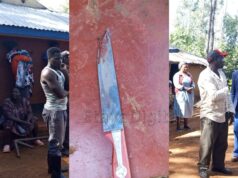
Kangogo was found dead inside a bathroom at her parents’ compound in Nyawa, Elgeyo-Marakwet County.
Her mother reportedly discovered the body.
Police said a Ceska pistol believed to have been connected to the killings was found near her body. The discovery immediately raised questions about how the wanted officer had managed to travel back to her family home without being intercepted.
The case, however, was far from over.
The message on her phone
Investigators later examined a lengthy message reportedly recovered from Kangogo’s phone.
Contemporary reports described the message as a suicide note in which Kangogo discussed her marriage, family difficulties and the two men she had been accused of killing.
She reportedly made requests concerning her funeral and asked to be buried in a white wedding gown. She also made claims about her relationship with Ogweno and alleged a financial dispute involving Ndwiga.
Those statements, however, represented Kangogo’s own account and were never tested through a criminal trial.
Her death meant the allegations against her would never be examined in court.
What did the autopsy reveal?
An autopsy conducted by Chief Government Pathologist Dr Johansen Oduor established that Kangogo died from a single gunshot wound to the head.
Oduor said further laboratory examinations were required to establish additional circumstances surrounding the shooting.
Her father, Barnaba Kibor, later rejected speculation that she had been murdered, maintaining that his daughter had taken her own life.
The conclusion brought the dramatic 10-day manhunt to an end, but questions surrounding the case continued to generate public discussion.
There would be no trial to establish the allegations against Kangogo, leaving much of the narrative dependent on police accounts, investigative findings and the contents of the message reportedly recovered from her phone.
A case that still raises questions
Caroline Kangogo’s story remains one of the most closely followed police cases in Kenya’s recent history.
It contained all the elements of a national mystery: a serving police officer accused of two killings, a missing firearm, reported movements across multiple counties, a nationwide search, mistaken identity and, finally, the discovery of the suspect dead at her own parents’ home.
For 10 days, detectives searched for Kangogo across the country.
In the end, the search did not lead to an arrest or a courtroom.
It ended at the place where her story had begun—with her family.
Kangogo was later buried at Nyawa Village in Elgeyo-Marakwet County.
What remains is a complicated and tragic chapter in Kenya’s criminal history—one that captured national attention in July 2021 and left behind questions that could no longer be answered in a courtroom.