The relationship between Kenya’s founding President Jomo Kenyatta and veteran nationalist Paul Ngei remains one of the most fascinating chapters in the country’s struggle for independence. Their story was marked by unwavering patriotism, political partnership, personal disagreements, and dramatic moments that have continued to intrigue historians for decades.
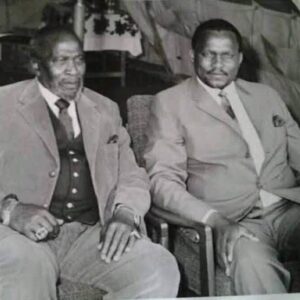
Both men were among the famous Kapenguria Six, alongside Bildad Kaggia, Fred Kubai, Achieng Oneko, and Kung’u Karumba. They were arrested in October 1952 following the declaration of the State of Emergency during the Mau Mau uprising and were later convicted after the Kapenguria Trial. The group spent years in detention, much of it in remote northern Kenya, including Lokitaung and Lodwar, enduring harsh conditions while becoming enduring symbols of the country’s fight for self-rule.
Although they shared the same dream of an independent Kenya, life in detention was not always harmonious. Historical accounts suggest that the two leaders occasionally clashed over personal and prison-related matters, revealing that even close comrades could experience moments of tension.
One of the most widely recounted stories from their imprisonment involves Kenyatta’s eldest daughter, Margaret Wambui. According to accounts cited by Kenyatta’s biographer Jeremy Murray-Brown and later reported by The Standard, both Kenyatta and Ngei regularly exchanged letters with people outside prison. During one such exchange, a mix-up allegedly led to Kenyatta receiving a letter written by Ngei that was intended for Margaret.
The letter reportedly contained affectionate and poetic language, leaving Kenyatta surprised. Anecdotal accounts claim that he jokingly confronted Ngei, saying, “Hey, what are you going to say now? I’ve caught you! You’ve kept quiet for a long time, and here you are, already my son-in-law without telling me!” While some versions describe the exchange as humorous, others suggest it created a period of strain between the two freedom fighters.
The reported incident has since become one of the most famous personal anecdotes surrounding the Kapenguria Six, with later newspaper features recalling the moment under headlines describing Kenyatta discovering Ngei’s alleged romantic interest in his daughter.
Their disagreements were not limited to personal matters. Accounts from their detention also indicate that Ngei questioned what he believed was preferential treatment given to Kenyatta in prison. It has been reported that Kenyatta was assigned kitchen duties, which Ngei felt were lighter than the work allocated to other detainees.
Historical records indicate that Ngei formally raised his concerns with prison authorities and even wrote to the District Officer at Lokitaung, J. J. de Delmege, seeking an explanation. The officer reportedly replied, explaining why Kenyatta had been assigned those particular responsibilities. Some narratives also allege that a heated confrontation occurred between the two prisoners during this period, although such claims have not been conclusively verified by historical evidence.
Despite these episodes of friction, the political relationship between Kenyatta and Ngei endured. After their release, Ngei initially charted his own political course by founding the African People’s Party (APP), which attracted considerable support in the Ukambani region. The party emerged as a significant political force ahead of Kenya’s 1963 General Election, positioning itself between Kenyatta’s Kenya African National Union (KANU) and the Kenya African Democratic Union (KADU).
Rather than remain in opposition, Ngei later negotiated the merger of APP with KANU. In September 1963, Kenyatta publicly welcomed his longtime colleague back into the fold during a gathering in Machakos, expressing his happiness at reuniting with a man “with whom I suffered for many years.”
Ngei subsequently served in Kenyatta’s government, demonstrating that despite personal disagreements and political differences, the shared struggle for Kenya’s independence ultimately prevailed. Their journey—from fellow prisoners to political allies—remains a remarkable reminder that even great leaders can experience conflict, reconciliation, and mutual respect while working toward a common national goal.