Relationships require trust, commitment and honesty to survive. However, maintaining a healthy relationship can become challenging when partners spend long hours away from home, interact with different people daily or work in environments that involve frequent travel, night shifts and demanding schedules.
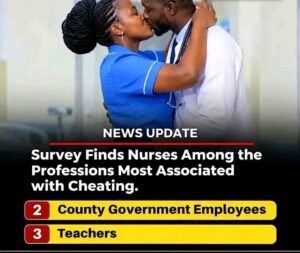

In Kenya, discussions about professions allegedly associated with relationship infidelity often generate heated debates on social media. Some occupations regularly feature in these conversations, with people pointing to workplace interactions, demanding schedules and opportunities to meet new people.
Although there is no reliable nationwide research establishing which professions have the highest rates of cheating, here are five careers that frequently attract attention in such discussions.
### 1. Nurses and other healthcare workers
Nursing is among the professions frequently mentioned whenever conversations about workplace relationships and infidelity arise.
Nurses often work long shifts, including overnight duties, weekends and public holidays. Their demanding schedules can sometimes limit the time they spend with their spouses and families.
They also work closely with doctors, clinical officers, laboratory technicians and other healthcare professionals, creating opportunities to develop close friendships.
However, these professional relationships should not automatically be interpreted as romantic affairs. Many nurses maintain healthy marriages despite the pressures of their careers.
### 2. County government employees
County government employees also frequently appear in discussions about workplace relationships.
Their jobs may involve meetings, field assignments, workshops, conferences and interactions with colleagues from different departments.
Some employees also travel to different parts of the country for official duties, occasionally spending several days away from their families.
These working arrangements can create opportunities for social interactions outside the home. Nevertheless, infidelity is a matter of individual choices rather than a characteristic of county employment.
### 3. Police officers
Police officers operate in demanding working environments that often involve irregular schedules, night patrols, transfers and deployments away from their families.
Some officers work for extended periods without returning home, while others are stationed in areas far from their spouses.
The close working relationships developed among officers, combined with shared experiences during difficult assignments, can create strong personal bonds.
However, police officers, like people in other professions, have different approaches to relationships, and their occupation alone cannot determine their faithfulness.
### 4. Teachers and lecturers
Teachers and lecturers are also sometimes mentioned in conversations about relationship challenges.
Their careers involve interacting with colleagues, parents, students and other education stakeholders.
Teachers may attend seminars, workshops, sporting activities and educational trips, sometimes spending considerable time away from home.
For lecturers, university conferences, research assignments and academic engagements can also involve travel and extended periods away from their families.
Despite these demands, many educators maintain stable and committed relationships.
### 5. Businesspeople and entrepreneurs
Businesspeople and entrepreneurs complete the list because their careers often involve networking, travelling, meeting clients and attending social and professional events.
Some entrepreneurs spend long hours building their businesses, while others frequently travel to different towns and countries in search of opportunities.
Business meetings, conferences, entertainment events and professional networking can expose them to different social circles.
The flexibility associated with some businesses may also mean spending considerable time outside the home.
### Is your profession responsible for cheating?
While these five careers frequently feature in public discussions about infidelity, it would be misleading to conclude that people working in them are more likely to cheat.
Relationship faithfulness depends on personal values, boundaries, communication, mutual respect and individual decisions.
A person can work night shifts, travel frequently or interact with hundreds of people daily and still remain faithful to their partner.
Similarly, someone working from home with limited social interactions can still engage in infidelity.
Ultimately, a successful relationship is not determined by one’s job title or workplace but by the commitment both partners make to protecting their relationship.
**What do you think? Which other profession do you believe is frequently associated with relationship infidelity in Kenya, and why?**


