For decades, the Bermuda Triangle has captured the imagination of people around the world. Often referred to as the “Devil’s Triangle,” this region of the Atlantic Ocean has become famous for stories of ships and airplanes that allegedly vanished without a trace.
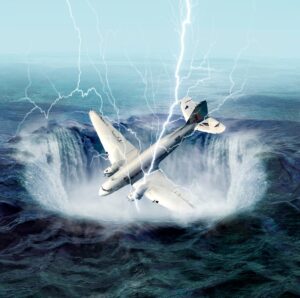
The Bermuda Triangle is an area roughly bounded by Miami in Florida, Bermuda Island, and San Juan in Puerto Rico. Covering hundreds of thousands of square miles, it lies along one of the busiest shipping and air travel routes in the world.
The mystery gained worldwide attention after several high-profile disappearances were linked to the region. One of the most famous incidents occurred in December 1945 when five U.S. Navy aircraft known as Flight 19 vanished during a routine training mission. The experienced pilots reportedly became disoriented and lost radio contact with their base. To make matters worse, a rescue aircraft sent to search for them also disappeared, fueling speculation that something unusual was happening in the area.
Over the years, many theories have emerged to explain these disappearances. Some people believe extraterrestrials are responsible, claiming that UFOs may have abducted aircraft and ships. Others suggest that the lost city of Atlantis lies beneath the waters of the Bermuda Triangle and emits mysterious energy capable of interfering with navigation systems.
However, scientists and researchers offer more realistic explanations. One of the most widely accepted theories involves unpredictable weather. The region is known for powerful storms, hurricanes, and sudden weather changes. A pilot flying into a severe storm can quickly lose visibility and orientation, while ships may face enormous waves capable of causing catastrophic damage.
Another explanation involves magnetic variations. Early navigators occasionally reported compass readings that differed from expected directions. While such variations can be confusing, experts note that they are natural phenomena found in different parts of the world and are not unique to the Bermuda Triangle.
Researchers have also studied the possibility of methane gas eruptions from the ocean floor. According to this theory, large bubbles of methane could reduce the density of seawater, causing ships to sink rapidly. If released into the atmosphere, the gas might also affect aircraft engines. Although scientists acknowledge that methane eruptions occur naturally, there is limited evidence linking them directly to the reported disappearances.
Human error remains another major factor. Pilots and ship captains navigating vast stretches of ocean can make mistakes, especially during poor weather conditions. Mechanical failures, fuel shortages, and navigation errors have been identified in many incidents once considered mysterious.
Today, most aviation and maritime experts agree that the Bermuda Triangle is not significantly more dangerous than other heavily traveled regions of the ocean. In fact, thousands of aircraft and ships safely cross the area every year without incident.
Despite scientific explanations, the Bermuda Triangle continues to fascinate people because of the unanswered questions surrounding some disappearances. Whether viewed as a natural hazard, a collection of unfortunate accidents, or a source of enduring legends, the Bermuda Triangle remains one of the world’s most intriguing mysteries.