In 1968, Kenya’s founding President, Jomo Kenyatta, came frighteningly close to death.
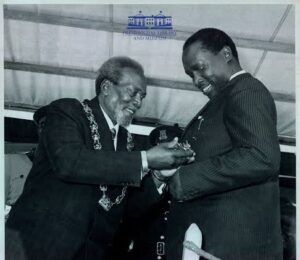

While on a visit to the Coast, Kenyatta suffered a serious stroke in Mombasa and remained unconscious for three days. As the nation waited anxiously, the men closest to him were forced to confront a reality they had long avoided: the Father of the Nation would not live forever.
What followed was one of the most secretive political operations in Kenya’s history—a confidential plan to manage not only Kenyatta’s funeral but also the delicate transfer of power after his death.
The man who initiated the process was Agriculture Minister Bruce McKenzie. Concerned about the potential chaos that could follow the death of such a towering figure, McKenzie quietly approached British High Commissioner Edward Peck. Together, they began crafting a detailed contingency plan behind closed doors.
The operation was classified “Top Secret.”
Officially titled Contingency Plan for Arrangements in the Event of the President’s Serious Illness or Death, the document laid out every detail of what would happen when Kenyatta eventually passed away.
Only a handful of powerful figures were allowed into the inner circle. They included Vice President Daniel arap Moi, Attorney General Charles Njonjo, Cabinet Minister and personal physician Njoroge Mungai, and senior military officer Colonel J.R. Anderson.
Ironically, none of them knew that British officials had helped design the plan.
Kenyatta himself was never informed.
Those involved feared that discussing his mortality could distress him. Instead, preparations quietly continued in the background.
The funeral arrangements were remarkably detailed. Upon his death, Kenyatta’s body would be transported to Gatundu for embalming before lying in state at State House Nairobi for three days. A grand state funeral would follow, culminating in burial at a specially designated national shrine. Even a custom-made coffin was secretly commissioned in London years in advance, while an embalming expert was placed on standby to fly to Kenya at a moment’s notice.
Yet the real battle was never about the funeral.
It was about who would inherit power.
Although Moi had been appointed Vice President in 1967, he remained an outsider among many members of Kenyatta’s influential Kikuyu inner circle. Behind the scenes, powerful figures believed that Moi’s role would be temporary.
Their preferred successor was Njoroge Mungai, a trusted Kenyatta ally and highly educated physician. The strategy was simple: Moi would automatically assume office after Kenyatta’s death, serve for 90 days as required by law, and then step aside after a national election delivered power to another candidate.
In June 1968, the succession framework was strengthened through a constitutional amendment. The law provided that the Vice President would become acting president for 90 days before fresh elections were held.
To Kenyatta’s allies, everything seemed perfectly arranged.
But history had other plans.
Kenyatta defied expectations and lived for another ten years. During that decade, Kenya’s political landscape changed dramatically. Potential successors disappeared from the scene, including the charismatic Tom Mboya, who was assassinated in 1969.
Meanwhile, Moi quietly strengthened his political networks across the country. He survived repeated attempts by rivals to block his path to power and patiently consolidated support within government and beyond.
Then came August 22, 1978.
Kenyatta died peacefully in his sleep at State House, Mombasa, ending an era that had shaped independent Kenya.
The secret succession plan drafted a decade earlier was finally activated.
But there was one crucial difference.
The outcome was not the one envisioned by the architects of the plan.
Instead of serving as a temporary caretaker, Daniel arap Moi used the constitutional pathway created years earlier to secure the presidency. The man many had underestimated became Kenya’s second president, ushering in a new political era that would last 24 years.
In a remarkable twist of history, the secret preparations made for Kenyatta’s death ultimately paved the way for Moi’s rise—a succession few among the political elite had truly expected when they first drew up the plans in 1968.