The political storm surrounding Kenya’s opposition has intensified, but Democracy for the Citizens Party (DCP) leader Rigathi Gachagua is insisting that what appears to be a deeply divided United Opposition is, in his view, far from breaking apart.
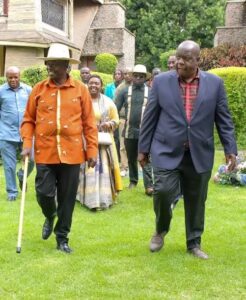
Speaking in Kajiado on Saturday, August 8, Gachagua sought to calm growing speculation that disagreements among opposition leaders could derail their ambitious plan to challenge President William Ruto in the 2027 General Election.
Rather than dismissing the disagreements, the former deputy president attempted to draw a line between political differences and the broader objective he says unites the opposition principals.
According to Gachagua, the leaders may disagree over strategy, but they remain united around one central position: President Ruto should serve only one term.
«“We are all in agreement on one thing, that Ruto is a one-term president. We all agree that the most workable formula to send William Ruto home is to have a single presidential candidate for the opposition,” Gachagua said.»
His remarks come at a time when questions have increasingly been raised about whether the opposition can overcome competing ambitions and present a united front against Ruto in 2027.
Gachagua named several leaders whom he said are committed to the single-candidate strategy. They include Kalonzo Musyoka, Fred Matiang’i, Martha Karua, Justin Muturi, Eugene Wamalwa, George Natembeya, Edwin Sifuna and David Maraga, alongside himself.
But behind the apparent unity lies a major political puzzle.
The opposition has yet to agree on three critical issues: how their joint presidential candidate will be selected, when the candidate should be unveiled and, perhaps most importantly, who will eventually carry the opposition’s flag.
Those questions could prove far more difficult to resolve as several principals position themselves for what promises to be one of Kenya’s most fiercely contested presidential races.
On the question of selecting the candidate, Gachagua revealed that different proposals have already been floated.
Some leaders, he said, suggested involving academic experts. Others proposed bringing in foreign consultants, while another camp favoured opinion polls to determine the most popular candidate.
Gachagua, however, rejected all three approaches.
He argued that the decision should ultimately belong to Kenyans themselves rather than experts, consultants or polling companies.
«“I, Gachagua, said no; let us go to the people; they are the ones to decide. This is our country; there is no need to call foreigners to teach us,” he said.»
But while Gachagua spoke of unity, the political undercurrents within the opposition remain impossible to ignore.
The biggest challenge may be the ambitions of the very leaders expected to unite behind one candidate.
Both Gachagua and former Interior Cabinet Secretary Fred Matiang’i are emerging as influential figures with presidential ambitions, creating the possibility of a direct contest within the opposition camp.
Their differences have already spilled into the political arena.
Gachagua’s DCP has viewed Matiang’i’s association with the Jubilee Party as a competing political vehicle that could potentially split the Mount Kenya vote—a constituency expected to play a decisive role in the 2027 succession battle.
Gachagua has also openly criticised Matiang’i’s political approach, accusing him of relying heavily on boardroom engagements and hotel meetings instead of building a grassroots political movement.
For Matiang’i’s allies, however, the criticism has raised another concern: whether Gachagua and his allies are attempting to dominate an opposition coalition whose strength depends on bringing together parties and leaders with different regional bases.
Some opposition figures and allies of Matiang’i have accused Gachagua’s camp of attempting to sideline or bully smaller coalition partners simply because they do not command large regional voting blocs.
The tension is further complicated by the relationship between Matiang’i and former President Uhuru Kenyatta.
Gachagua has maintained a strained political relationship with Uhuru, and Matiang’i’s close ties to the former president have reportedly fuelled suspicion within Gachagua’s camp.
Yet, despite these competing interests, Gachagua maintains that the opposition’s ultimate objective remains unchanged.
The challenge now is whether that shared objective will be strong enough to overcome personal ambitions, party rivalries and regional calculations.
With the 2027 election drawing closer, the opposition faces a defining test: Can leaders who each have presidential ambitions agree to step aside for one candidate—or will their competing ambitions hand President Ruto an advantage?
For now, Gachagua insists that the United Opposition remains intact.
But the real battle may not be about whether they can agree that Ruto should be defeated.
It may be about who will be willing to give up the chance to be the person who defeats him.