Before Mercy Njeri became the name of a busy shopping centre, a road, and two schools along Kabarak Road on the outskirts of Nakuru City, she was simply a bright, cheerful 10-year-old girl with big dreams.
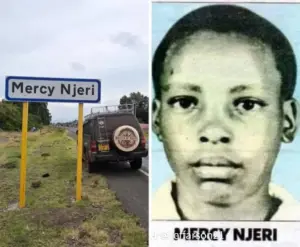
Thousands of motorists pass through the bustling Mercy Njeri Shopping Centre every day, while hundreds of learners proudly attend Mercy Njeri Primary School and Mercy Njeri Secondary School. Few, however, know the heartbreaking story behind the name that has become part of Nakuru’s history.
Mercy was born in Kiamunyi in 1975 and enjoyed a normal childhood until she was six years old. Then everything changed. She began experiencing persistent breathing problems and frequent illnesses that left her family desperately searching for answers.
Doctors eventually diagnosed her with rheumatic heart disease, a condition that had severely damaged her heart. The only hope of saving her life was a complex heart operation in the United Kingdom. The procedure and travel expenses would cost KSh500,000—a staggering amount that was far beyond what her family could afford in the mid-1980s.
Despite organising community fundraisers, the family managed to raise only a fraction of the required amount. As time passed, hope slowly faded.
Then fate intervened.
On February 4, 1985, the late President Daniel arap Moi made an unexpected visit to Kiamunyi Primary School, where Mercy was a Standard Three pupil. Realising this might be the family’s only chance, the headteacher courageously approached the President and explained the young girl’s critical condition. He also shared Mercy’s greatest dream—to one day become a doctor and help others.

The story touched President Moi deeply.
Without hesitation, he directed that funds be raised immediately. Mercy’s father was invited to State House in Nakuru, where the President personally undertook to meet the full cost of the life-saving surgery and all travel expenses.
Filled with hope, Mercy left Kenya for the United Kingdom on March 14, 1985.
Two weeks later, on March 29, she underwent an intensive 12-hour heart operation. Doctors fought tirelessly to save her life, but despite their efforts, Mercy passed away later that night.
Her body was flown back to Kenya, and on April 6, 1985, family, friends, and mourners gathered in Kiamunyi to bid her a final farewell. In a remarkable show of compassion, President Moi attended the funeral.
It was during the burial that Mercy’s headteacher made an emotional request. He asked the President if the school could be renamed in honour of the little girl whose courage had inspired so many.
President Moi agreed.
Although Mercy never realised her dream of becoming a doctor, her legacy has endured for more than four decades.
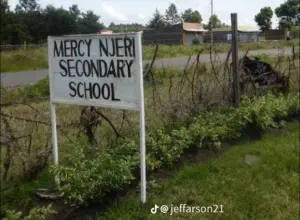
Today, her name lives on through Mercy Njeri Primary School, Mercy Njeri Secondary School, Mercy Njeri Shopping Centre, and Mercy Njeri Road—landmarks that continue to remind generations of a young girl whose brief life left an unforgettable mark on her community.
Her family’s commitment to preserving that legacy has never wavered. They continue supporting the schools, recently renovating and furnishing two classrooms and planning the construction of a modern library for learners.
For Mercy’s father, seeing his daughter’s name continue to inspire an entire community remains both humbling and deeply emotional.
Mercy Njeri’s story is a powerful reminder that a person’s legacy is not measured by the number of years they live, but by the lives they touch. Though she left the world at just 10 years old, her name continues to educate, inspire, and give hope to countless people every single day. 🕊️