Losing a job can be one of life’s most devastating experiences. For many people, it brings uncertainty, financial struggles, and shattered dreams. While some never fully recover from the setback, others use it as a stepping stone to greater success. One such person is Caleb Karuga, a former television journalist whose remarkable journey from the newsroom to the farm has inspired thousands of Kenyans.
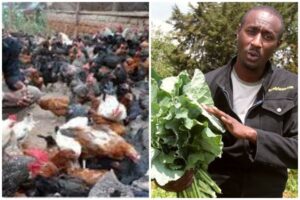
Today, Caleb is celebrated as a successful agribusiness entrepreneur, but his path to success was anything but smooth.
Born and raised in Kenya’s Central Province, Caleb initially moved to Nairobi to pursue a degree in Information Technology. However, midway through his studies, he realized that his heart was not in IT. Rather than continue on a path he did not love, he made the bold decision to leave university and follow his passion.
While in school, he had developed basic skills in videography and filmmaking. Armed with a camera purchased using his savings, he began filming weddings, funerals, church events, and any other assignments he could find. His dedication and creativity quickly earned him a reputation, enabling him to establish his first company, Target Creations, in 2003.
His life-changing breakthrough came in 2007 when renowned businesswoman and beauty pageant organizer Terry Mungai noticed his exceptional talent. Impressed by his work at a church event, she offered him a prestigious opportunity to serve as the official videographer for the Miss World Pageant finals held at the Kenyatta International Convention Centre.
The assignment earned him KSh 250,000 and opened doors to valuable professional networks. Soon after, as K24 Television was launching, Caleb used footage from the pageant to apply for a position. He was hired as both a reporter and cameraman, beginning what seemed like a promising media career.
For six years, he worked at , building his reputation as a journalist. Then in 2013, everything changed. The station downsized, and Caleb was among employees who lost their jobs.
Many would have viewed the retrenchment as the end of the road. Caleb saw it as the beginning of a new chapter.
Armed with a KSh 1.3 million compensation package, he started exploring business opportunities. One day while travelling to Naivasha, he met a mole trapper whose story completely transformed his perspective. The man earned approximately KSh 2,600 a day trapping moles on farms—more than Caleb was earning in employment.
That encounter sparked a new dream.
Inspired by the earning potential in agriculture, Caleb leased an acre of land in Kikuyu and established Wendy Farms. What followed, however, was a series of painful lessons.
His first venture involved purchasing 200 pigs without conducting adequate research. The project failed. Undeterred, he ventured into poultry farming by buying a few chickens from a neighbour. Unfortunately, due to a lack of knowledge about vaccinations, disease wiped out nearly 200 birds within two months.
Determined to succeed, he bought 500 day-old chicks from KARI. Yet another setback awaited him when dishonest employees sold many of the chicks while he was away.
As if that was not enough, he later leased farmland in Lamu but neglected to sign a formal lease agreement. One day, the landowner evicted him, and with no written contract, he had no legal protection.
Failure after failure tested his resolve, but Caleb refused to quit.
Instead, he treated every setback as a lesson. He studied agriculture, sought advice from experienced farmers, and continually improved his farming methods.
Today, his persistence has paid off handsomely.
Caleb now operates thriving farms in Kikuyu, Nyeri, and Laikipia. His agricultural ventures include poultry farming, dairy farming, and crop production. His farms are home to thousands of indigenous chickens, quails, guinea fowls, dairy goats, and cattle. He also grows sweet potatoes, strawberries, sunflowers, and butternuts.
Beyond farming, he has built a thriving agribusiness ecosystem. He supplies eggs to supermarkets, sells chicks and mature birds, and has trained more than 1,200 aspiring farmers across Kenya.
His story serves as a powerful reminder that success is not determined by how many times you fail, but by your willingness to rise every time you fall. What began as a devastating job loss ultimately became the foundation for an agribusiness empire that continues to transform lives and inspire entrepreneurs across the country.
For Caleb Karuga, losing a job was not the end—it was the opportunity that led him to discover his true calling.