Africa has witnessed some of the world’s longest-serving leaders, with several presidents remaining in power for decades. While supporters often praise these leaders for providing stability and continuity, critics argue that extended periods in office can slow democratic renewal and limit opportunities for younger generations to participate in national leadership.
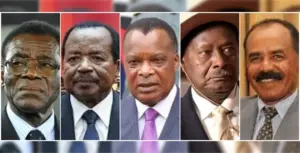
Currently, one of Africa’s oldest serving presidents is Paul Biya of Cameroon. Having assumed office on 6 November 1982, Biya has led the Central African nation for more than four decades. Born on 13 February 1933, he is also among the oldest sitting heads of state in the world.
Paul Biya became president after the resignation of Ahmadou Ahidjo, Cameroon’s first president. Over the years, he has won multiple presidential elections and overseen significant political and economic developments in the country. His supporters credit him with maintaining national unity and ensuring relative political stability in a region that has experienced numerous conflicts.
However, Biya’s lengthy rule has also attracted criticism from opposition leaders, civil society organizations, and international observers. Critics argue that Cameroon has faced challenges including corruption, youth unemployment, restrictions on political freedoms, and the ongoing Anglophone crisis in the country’s Northwest and Southwest regions. These issues have fueled repeated calls for political reforms and leadership transition.
Another veteran African leader is Teodoro Obiang Nguema Mbasogo of Equatorial Guinea. Obiang came to power in 1979 after a military coup and has remained president ever since, making him one of the longest-serving non-royal heads of state in the world. During his tenure, Equatorial Guinea transformed into one of Africa’s leading oil-producing nations. Despite the country’s oil wealth, concerns have persisted over income inequality, governance, and human rights.
In Uganda, Yoweri Kaguta Museveni has served as president since 1986 after leading a successful armed struggle that ended years of political instability. Museveni is credited with restoring stability, improving infrastructure, and promoting regional peace initiatives. At the same time, his prolonged stay in power has generated debate over constitutional amendments, electoral competition, and democratic governance.
The Republic of the Congo is led by Denis Sassou Nguesso, who first became president in 1979 and returned to office in 1997 after a period out of power. His decades-long political influence has made him one of Africa’s most experienced leaders, although his presidency has also faced criticism from political opponents.
Long-serving presidents often argue that experience is essential for implementing long-term development plans and maintaining national stability. They believe that continuity in leadership allows governments to complete major infrastructure projects, strengthen institutions, and pursue consistent economic policies.
On the other hand, many political analysts believe that regular leadership transitions are a vital part of a healthy democracy. They argue that peaceful transfers of power encourage accountability, promote innovation, and allow new leaders with fresh ideas to address evolving national challenges.
Across Africa, the conversation about presidential term limits remains one of the continent’s most significant political debates. While several countries have adopted constitutional limits on presidential terms, others have amended or removed these restrictions, allowing incumbents to remain in office for extended periods.
As Africa’s youthful population continues to grow, many citizens are increasingly calling for greater political participation, transparent elections, and stronger democratic institutions. At the same time, others maintain that leadership should ultimately be determined by the will of voters through free and fair elections rather than by the number of years a leader has served.
The story of Africa’s oldest serving presidents reflects the continent’s diverse political landscape. Their long tenures have shaped the history, economies, and institutions of their respective countries, leaving legacies that continue to spark admiration, debate, and discussion across Africa and beyond.